
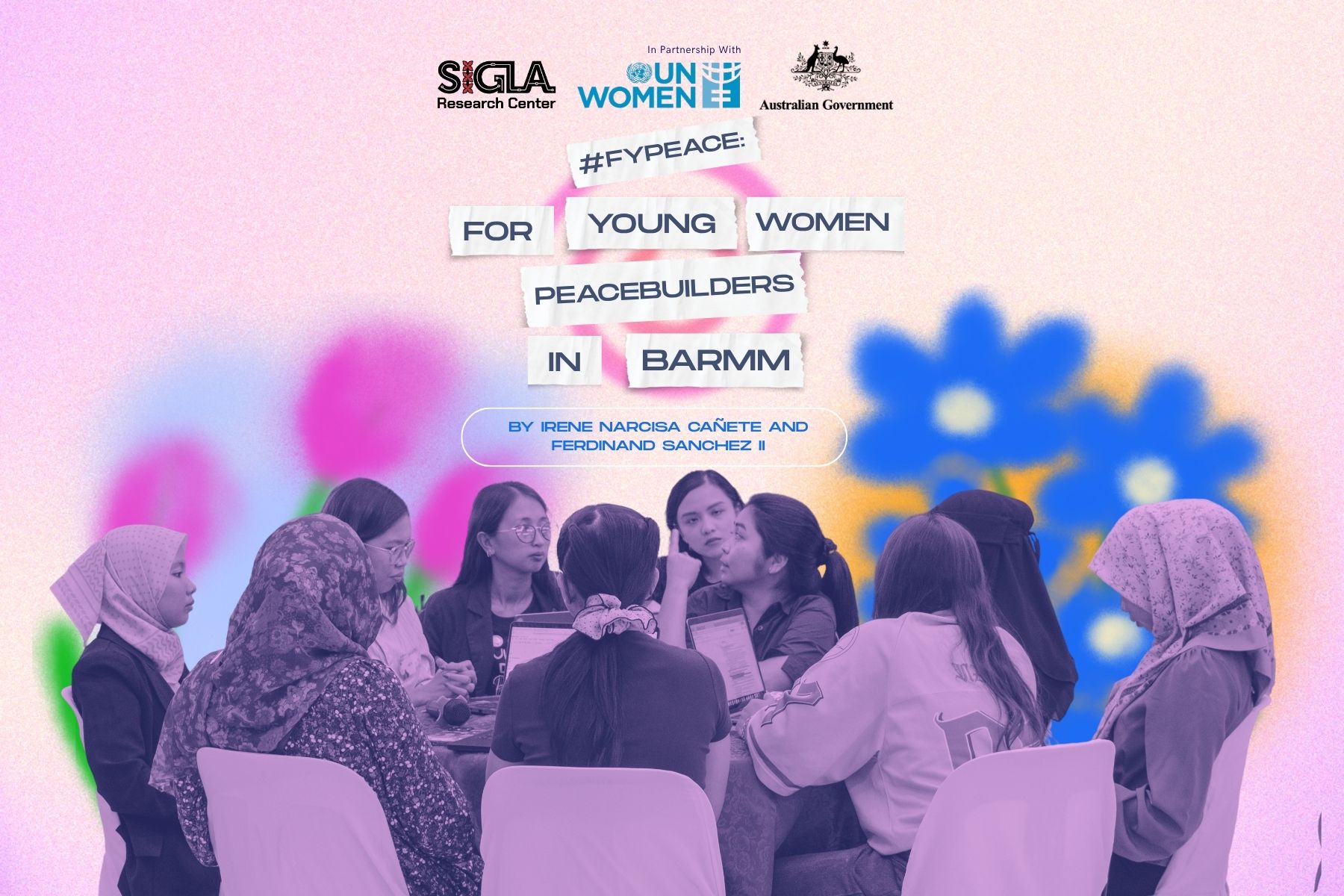
With every click and post we make online, we're already creating real impact, both in our communities and in the ways it quietly moves the work of peacebuilding forward. Each of these small acts matters, and deserves to be recognized and built on together. With this in mind, Sigla Research Center partnered with UN Women Philippines for #FYP: For Young Women Peacebuilders. This is a four-month fellow-centered program with 24 young women peacebuilders from across the Bangsamoro Autonomous Region in Muslim Mindanao (BARMM) to talk through their key issues, experiences, and ways forward.
The program builds on the current work of peacebuilders in BARMM, most importantly in how they use online tools and platforms for their respective advocacies, especially in anticipation of the region's first parliamentary elections.
#FYP stands for "For Young Women Peacebuilders," echoing the familiar feed we scroll through every day. This wordplay is also a symbol of our everyday participation in public life, whether that's sharing a post, leaving a comment, or using messaging platforms to mobilize and share information, even amid disinformation and online harassment.
Deliberative democracy is the core principle guiding the program. It is grounded in a diverse selection of young women from across BARMM's geographic and ethnolinguistic communities, dedicated online spaces for dialogue and reflection on their lived experiences and aspirations, and the convening of a range of stakeholders across BARMM around the work of peacebuilding.
This took shape through the following: small-group dialogues and a co-creation workshop that grounded the program in fellows' lived experiences, a public lecture series that opened the conversation to a wider audience, hands-on masterclasses that built on fellows' existing digital and deliberative practices, and a culminating in-person workshop in Zamboanga City in June, where fellows presented their recommendations to partners and government stakeholders.
As the fellows discussed several topics virtually and then met personally in Zamboanga, three words were most frequently mentioned—peace, digital, and democracy. The fellows mentioned these words as a testament to their experiences, personal histories, and aspirations. Despite this, these words continue to be contested in our daily lives. How do we make sense of these concepts when they are continuously challenged by disinformation, institutional gaps, and exclusivity? If peace is brittle, democracy is worn out, and the digital sphere serves both as a battlefield and a sanctuary, what does it mean to advocate for all of it at the same time?
We'd like to point out the importance of conversations in this program; they bring out so many things. Experiences, grief, happiness, and learning. We learn from these exchanges not despite, but because of the diversity of our definitions. We learn that peace can be a destination for some, and a daily occurrence for others; that the digital world can be a tool for liberation or a weapon to support oppression. And that democracy needs constant tending, especially when threatened. Ultimately, what's unique about this program is that its goal was never to resolve tensions, but to hold them—create genuine spaces for them, with the understanding that vulnerability is not a sign of weakness, but a currency of resilience.
We ended the fellowship with one certainty: that peace is a lifetime commitment, and the road never gets easier. The path ahead is still uncertain and steep, but we will no longer walk it alone—a shared burden is a light burden. For peace, after all, is a practice—one that this fellowship has now woven not into our work, but into the fabric of who we are and our advocacies.
This blog is part of a series based on Sigla Research Center’s #fyp: For Young women Peacebuilders, a digital peacebuilding program with young women leaders in the Bangsamoro Autonomous Region in Muslim Mindanao (BARMM) in partnership with UN Women Philippines, and supported by the Australian Government through the Department of Foreign Affairs and Trade (DFAT).